
Whitepaper
Whitepaper · 35 pages
Repair or Replace? The After-Sales Playbook for Chinese Robotics Entering Europe
Chinese robot makers are entering Europe faster than their after-sales systems can follow. Humanoid platforms, quadrupeds, delivery robots, lawn robots and commercial cleaning fleets are arriving through distributors, marketplaces and direct-to-consumer web shops — while the service infrastructure behind them lags by two to four years. This white paper answers the one operational question that decides whether a brand survives its second year in Europe: repair or replace? It is not a slogan; it is a calculation with four variables — hardware price, logistics friction, labour cost and warranty liability — and the balance point is different for every price tier and every product category.
Five findings that drive everything
Our structured review of 28 robot brands selling into Europe produced five findings:
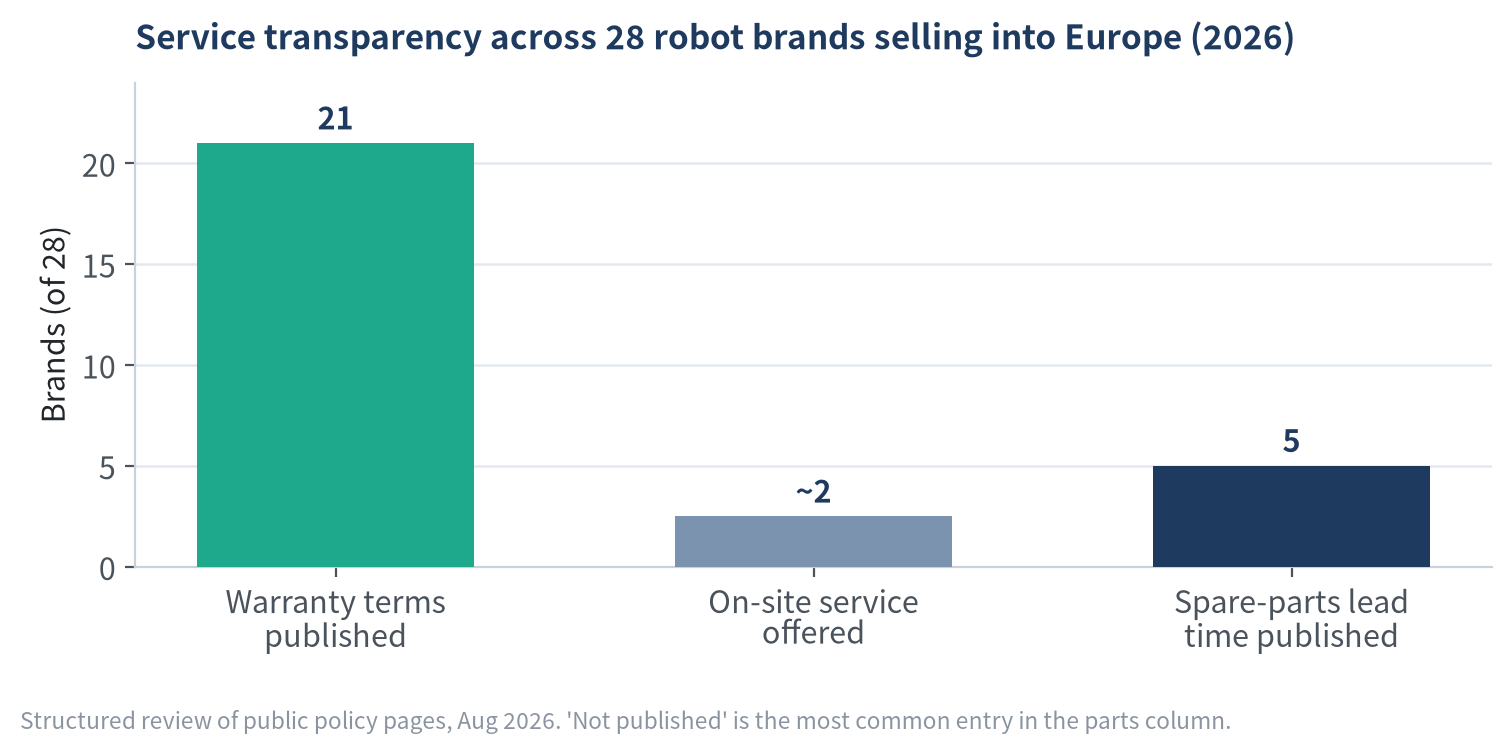
- The service-terms gap is wide and measurable. Spare-parts lead time was published by fewer than one in five brands; on-site service by fewer than one in ten; roughly a quarter had no published warranty terms a European buyer could rely on at all.
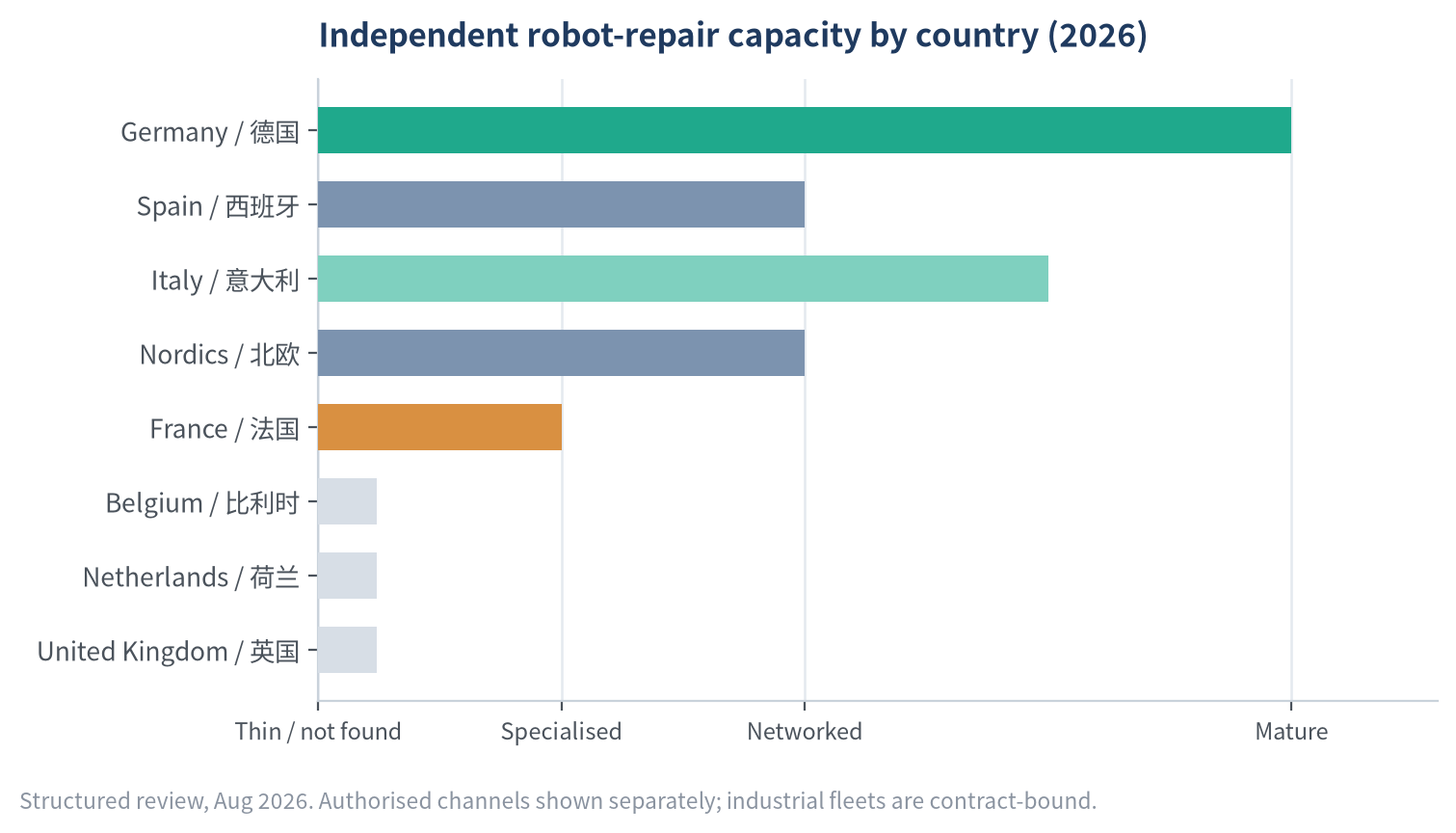
- The European service ecosystem is fragmented. Independent repair is mature in Germany (dedicated workshops with published diagnostic fees and component-level board repair), networked in Spain, strong in lawn robots in Italy — and effectively absent in the Netherlands and the United Kingdom. Authorised channels and independent repairers are two separate systems that rarely overlap.
- The compliance clock is already running. The EU Right to Repair Directive (2024/1799) requires member-state transposition by 31 July 2026. The Batteries Regulation (2023/1542) brings battery-passport obligations from 18 February 2027 — including replacement and spare batteries shipped during a 10–20 year service life. A brand entering Europe in 2026 without a repair strategy is not merely inconvenient; it is on a collision course with law.
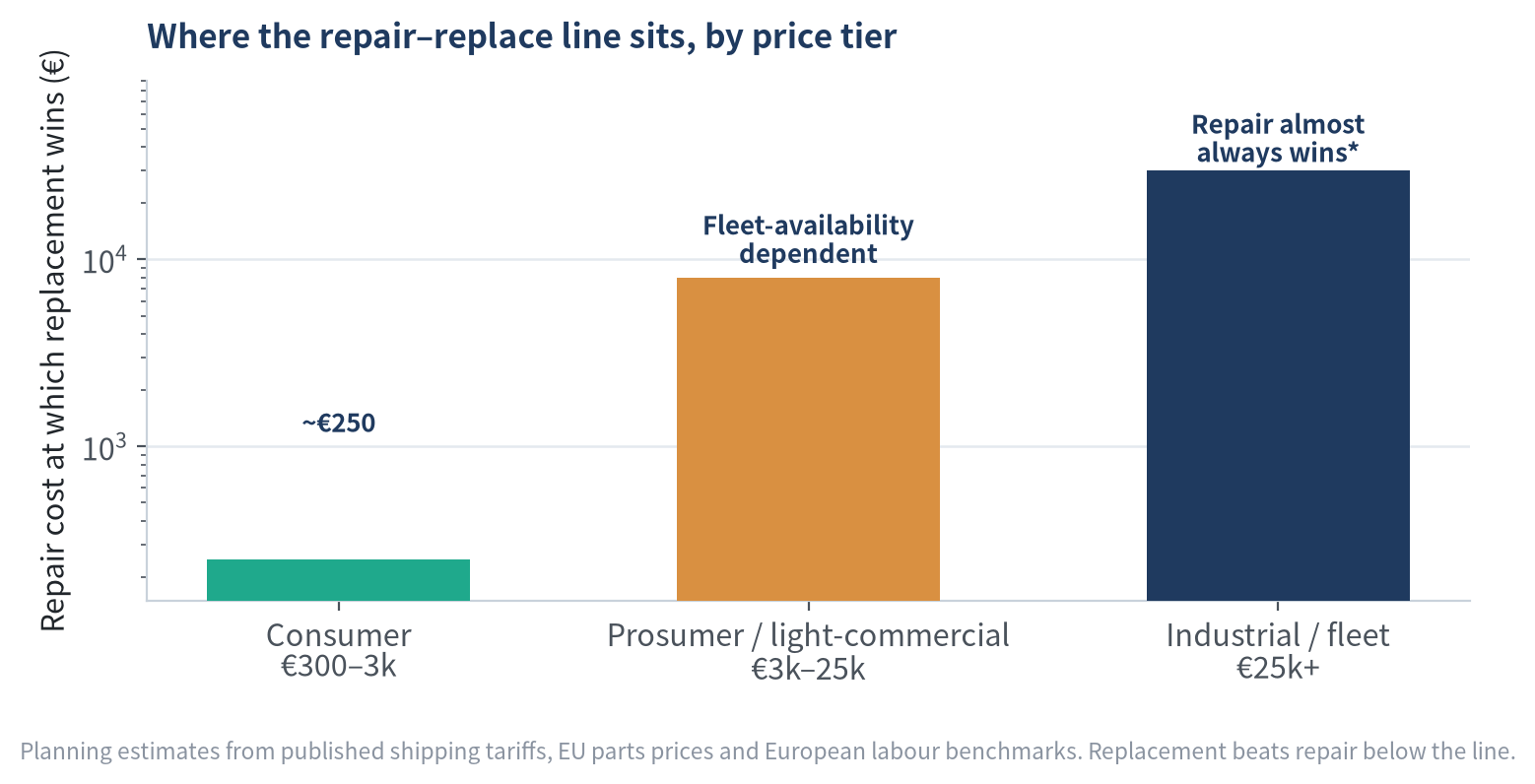
- The economics are counter-intuitive. For low-priced consumer robots, replacement beats repair at roughly €250 of total repair cost — which a single cross-border shipment plus two hours of European labour already exceeds. Above €10,000, repair almost always wins, but only if parts, documentation and trained technicians exist locally. The expensive failure mode is not repair; it is the unmanaged middle: slow return-to-factory loops that destroy fleet uptime and brand reputation simultaneously.
- Three service models cover every realistic entry strategy. Manufacturer-authorised networks, distributor-led pre-sale service, and marketplace selling with no service layer. Each is viable; each has a defined cost floor; and each fails in a predictable way.
What the data shows
Across the 28 brands reviewed, the most common entry in the spare-parts column was simply “Not published.” At the detailed end of the spectrum, Segway Navimow publishes component-level terms (two years machine, one year battery, blades excluded as consumables) with EU-only extended-warranty rules down to activation windows and serial-number transfer mechanics. Mammotion prices parts openly in its EU store — blades at €49–55, batteries at €219. AgiBot publishes an overseas policy with a 30-minute first response, repair measures within seven working days, and whole-unit replacement as fallback. At the blunt-but-honest end, EngineAI publishes on-site service at US$500 per person-day plus travel. At the minimal end, several high-growth brands publish nothing a European buyer can rely on before purchase.
Inside the report
- Chapters 1–2 — Why now: the entry wave meeting the service gap, and why 2026–2027 is the decision window (the Right to Repair transposition deadline and the battery-passport start date).
- Chapter 3 — The compliance map: Right to Repair, the Batteries Regulation, CE/RED/Machinery, WEEE and reverse-logistics paperwork, and GDPR in the service workflow.
- Chapter 4 — After-sales economics: where the repair–replace line sits per tier (consumer, prosumer, industrial) and the downtime multiplier that dominates every calculation.
- Chapter 5 — The three service models, with live examples and a decision table mapping price tier to model choice.
- Chapter 6 — Spare parts and logistics: the transparency gap, the European repair map, and ADR battery-transport rules (SP376 / P908 / P911 / LP906).
- Chapters 7–8 — A buyer’s ten-question scoring framework and a manufacturer’s 24-month roadmap with cost estimates.
- Appendices — Pre-purchase and service-readiness checklists, country snapshots, a regulatory quick-reference table and a full 28-brand warranty spectrum.
Key figures
Who should read it
- Chinese manufacturers planning European entry or defending existing sales, who need to choose and price a service model.
- European distributors, integrators and fleet buyers, who need to price service risk into procurement decisions.
- Service investors and operators — including specialist networks such as Robanchor — who need to understand where independent capacity is genuinely needed versus already covered.
Why this matters now
The first wave of Chinese robots in Europe competed on hardware novelty and price. The second wave — the one now forming — will be won on service evidence: published terms, named service points, priced parts and documented reverse loops. A buyer deciding between two comparable robots in 2027 will not read the spec sheets twice; they will read the warranty page once. The empty column in a service directory — “Not published” — is the loudest sentence in this market, and the brands that fill it first will own the trust layer of European robotics.
About the research
All industry data is drawn from public sources — manufacturer policy pages, reseller listings, EU regulation and national registers — accessed in August 2026 and cited at the end of every chapter. Robanchor’s own projections are marked as estimates. Robanchor is the robotics after-sales brand of BessRe Belgium BV (Boomsesteenweg 690, 2610 Wilrijk, Belgium; 900 Yishan Road 2204/C, 200233 Shanghai, China), sharing its operating entity with the BessRe energy-storage services business. The white paper makes no claims about customer counts or engineer headcounts.